

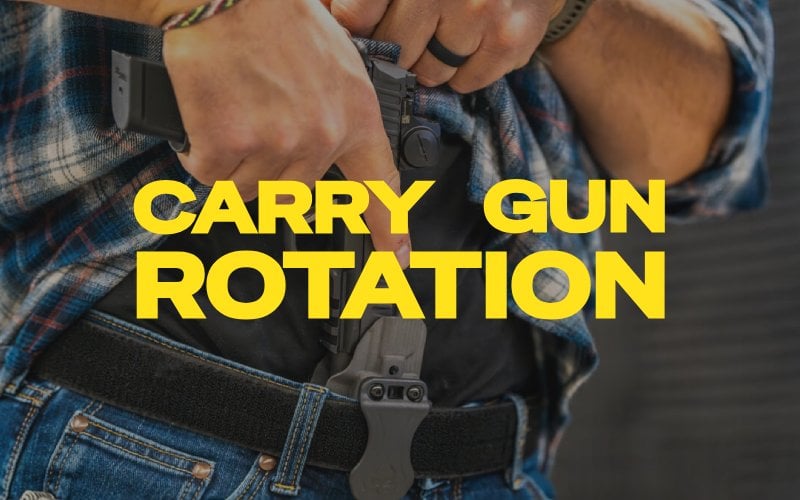
Below, we break down the core arguments from both sides of the CCW rotation debate and share practical guidance on structuring a carry setup the right way.
The Case for Sticking With One Gun
The loudest argument in this space is simple: consistency saves lives. Under a genuine threat, your brain doesn’t have time to consciously think through which gun is on your hip, where the safety is, or how heavy the trigger pull is that day. It defaults to whatever’s been drilled in through repetition.
If that muscle memory was built on a different gun than the one you’re actually carrying, you’re gambling with a fraction of a second you don’t have.
There’s also a training math problem. Time and ammo are finite. Split your practice across three or four different platforms, and you’re diluting the depth of training with each one instead of building deep, reflexive proficiency with a single system.
That’s why so many carriers treat their firearm choice the way a firefighter treats gear placement – everything goes in the same spot, every time, so the hands know where to go without a thought.
The Case for Rotating
On the other side, plenty of carriers argue that clothing and climate are real variables you can’t just ignore. A heavy winter coat hides a full-size gun easily. A t-shirt and shorts in July? That same gun prints like a brick taped to your waist.
So the rotation isn’t about boredom or liking variety for its own sake – it’s about staying comfortable enough to actually carry consistently, instead of leaving the gun at home because it’s too much hassle to conceal.
It’s not only about weather, either. Plenty of carriers keep a separate setup for specific situations or activities: a “woods gun” in a larger caliber for hiking or wildlife country, or a pocket pistol for a quick trip to the mailbox. The logic here isn’t “I felt like changing it up today” – it’s “this specific context demands something different.”
Match the tool to the constraints of the day – that’s the approach of CCW rotation advocates.
Concealment Dynamics
Dallas-Fort Worth, Texas.
The Middle Ground Most People Actually Land On
Most experienced carriers aren’t purely one-gun-forever or purely switch-whenever-they-feel-like-it. They rotate, but only within a tight, deliberate boundary – guns that share the same manual of arms.
That means sticking to striker-fired pistols with no manual safety across the board, or staying within one brand’s lineup where the trigger, grip angle, and controls feel nearly identical no matter the frame size. Swap between a compact and subcompact from the same family, and your draw, grip, and trigger press barely change. Swap between a 1911 with a thumb safety and a striker-fired gun with none, and suddenly you’re adding a decision point your brain has to process at the worst possible moment.
Glock is a classic example of a brand that is perfect for building a rotation setup (G26 for deep concealment + G19 for daily carry, for instance), but it’s not the only one that you can consider. SIG Sauer P365, Smith & Wesson M&P, Walther PDP, CZ P-10 all feature several differently sized variants within one family.
Pay attention, P365 and Shield Plus lineups offer versions with and without a manual thumb safety.
The other non-negotiable in this middle ground: training every gun in the rotation, not just the one you happen to carry most. A rotation only works if every piece of it gets regular range time. The moment one gun sits in a drawer for months while you focus on another, it’s no longer part of a trained system.
At GRITR Range, we have plenty of cool pistols for rent, including several variants of the SIG P365 and Glocks. Some rentals sport pre-installed optics. Come try these out!
A Word on Revolvers in Carry Rotation
A revolver is the simplest gun you can add to a rotation: no manual safety, no slide to rack, and nothing to disengage before firing. Point and press. That’s why pairing a striker-fired pistol with a snub-nose revolver is one of the more forgiving mixed-system rotations.
BUT a revolver changes several things your training has to account for, such as a long and heavy trigger pull and recoil management (especially if you carry +P ammo).
There’s also a cleaner option for revolver fans: an all-revolver rotation. Carrying a K- or L-frame .357 most of the year and dropping to a J-frame in summer keeps the manual of arms identical. The trigger, the reload, and the grip change only slightly.
A Good Holster and Belt Can Solve More Than You Think
One point that comes up constantly, and deserves more attention than it usually gets: a lot of the “I need a smaller gun for summer” problem isn’t really a gun problem. It’s a gear problem. A quality holster, a stiff belt, and the right carry position (appendix carry, in particular, gets a lot of credit here) let plenty of people conceal a gun like Glock 19 in January and July without changing a thing. If you’re finding yourself needing a drastically different gun every season, it might be worth troubleshooting your setup before assuming the fix is another purchase.
So, Should You Rotate Your CCW?
As you can see, philosophies differ. But if you’re going to rotate, here are a few rules:
- A small, deliberate rotation – two or three guns
- Same manual of arms across the rotation – same trigger type, same safety setup (or lack of one), same basic controls
- Train every gun like it’s your only gun. If you can’t commit to that level of practice across multiple platforms, one well-trained gun beats three half-trained ones every time.
- Seasonal or situational logic, not random preference
Get To Know GRITR Range
If you happen to be around North Richland Hills, don’t miss the chance to stop by GRITR Range. We have a top-notch facility designed for both beginners and seasoned shooters. GRITR Range boasts 22 cutting-edge lanes and can accommodate handguns in up to .50AE and rifles in up to .308.