

So you’ve decided to get your carry license in Texas. Good call. This post walks you through the whole ordeal of getting your TX LTC. Let’s cut to the chase!
What Is Texas LTC?
The Texas License to Carry is the state-issued permit that allows you to carry a handgun (openly or concealed) on your person in Texas and in dozens of other states. Before 2015, it was called a Concealed Handgun License (Texas CHL). The name changed when open carry became legal. The permit itself is the same; it just covers more ground now.
Texas switched to permitless carry in 2021, which means qualifying residents can carry without any license. But that doesn’t make the LTC irrelevant – far from it.
With an LTC, you get access to places where permitless carriers aren’t allowed, a bypass on federal background checks at the point of firearm purchase, and reciprocity in 37 other states. The class itself also gives you a real education in Texas use-of-force law, which most gun owners never get otherwise.
In short, the TX LTC takes a few hours of your time and costs $40 to apply. What it gives you back is a broader set of rights and a much clearer understanding of when you can and can’t legally use your gun.
BOOK LTC CLASS AT GRITR:
Co-Ed Texas LTC
Women-Only Texas LTC
Online Texas LTC
The Two Parts of the Texas LTC Course
To get your Texas LTC, you have to complete two separate components:
- Classroom instruction – 4-6 hours of legal and safety education, followed by a 25-question written exam
- Live-fire proficiency demonstration – 1-2 hours of range instruction + a 50-round shooting qualification
Both must be completed before you can submit your application to Texas DPS.
Part 1: Texas LTC Classroom Session
What Actually Gets Covered
The classroom portion covers four subject areas required by Texas DPS:
- Laws regarding use of force and deadly force – When are you legally allowed to draw? When does “castle law” apply? What’s the difference between defending your home and defending yourself in public?
- Handgun use and safety – How handguns function, safe handling habits, proper storage at home (especially with kids around)
- Non-violent dispute resolution – De-escalation strategies and why avoiding confrontation beats winning one
- The criminal and civil court systems – What happens legally if you’re involved in a defensive shooting, and how to protect yourself
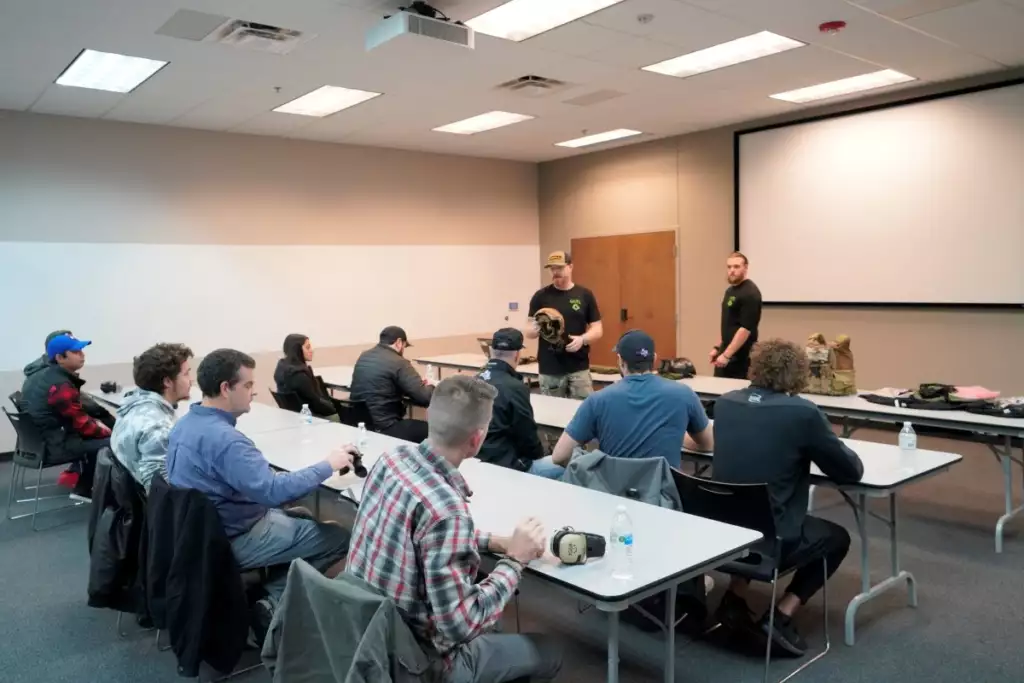
At GRITR, instructors run through this material with a PowerPoint presentation and open discussion format. The class covers Texas-specific statutes – TMPA (Texas Motorist Protection Act), the Castle Doctrine, signage laws (30.06/30.07) – and also gets into what to say (and what not to say) to law enforcement after a critical incident.
Written Exam
At the end of the classroom session, you’ll take a 25-question LTC test covering the four topics above. Texas DPS sets the questions; the passing threshold isn’t published as a specific percentage, but the content is straightforward. If you followed the lecture, you’ll pass. There’s no trick to it.
What to Bring to the Classroom
- Valid Texas state ID or driver’s license
- Pen and paper for notes
- Water, a snack or lunch (six hours goes faster with fuel)
Part 2: The Live-Fire LTC Proficiency Test
This is the part that tends to make people nervous. It shouldn’t.
The LTC shooting test exists to confirm that you can safely handle and fire a handgun, not to assess marksmanship. Texas wants to see that you can load, grip, aim, and fire without putting anyone in danger. That’s the bar.
The Setup
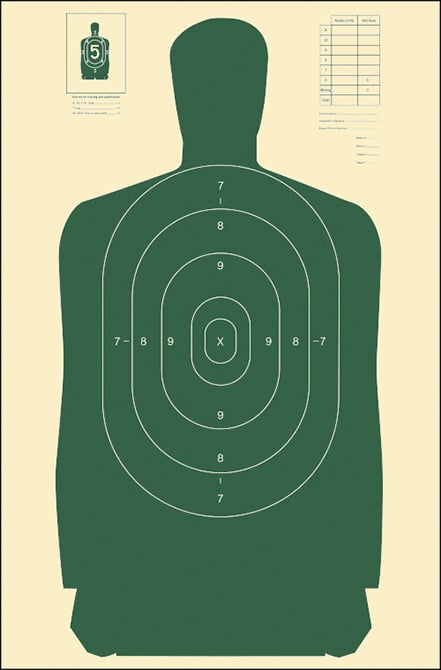
The qualification uses a B-27 target, which is a full-sized human silhouette, 45 inches tall by 24 inches wide. You fire 50 rounds total from three different distances. All shooting starts from the ready position, meaning the gun is already in your hands. No drawing from a holster, no shooting from concealment.
Scoring works like this:
- Shots in the 8, 9, or 10 rings (the tightest inner zone) — 5 points each
- Shots in the 7 ring — 4 points each
- Shots inside the silhouette but outside the rings — 3 points each
- Shots outside the silhouette — 0 points
With 50 rounds fired at 5 points max per shot, a perfect score would be 250. You need 175 to pass (that’s 70%). Do the math: you could miss the scoring rings entirely on every shot at 15 yards and still come out ahead if you hit cleanly at the shorter distances.
The Course of Fire
Here’s exactly what you’ll shoot and when:
3-yard line — 20 rounds total
- 1 shot in 2 seconds, 5 times
- 2 shots in 3 seconds, 5 times
- 5 shots in 10 seconds, once
7-yard line — 20 rounds total
- 5 shots in 10 seconds, once
- 1 shot in 3 seconds, 5 times
- 2 shots in 4 seconds, once
- 3 shots in 6 seconds, once
- 5 shots in 15 seconds, once
15-yard line — 10 rounds total
- 2 shots in 6 seconds, once
- 3 shots in 9 seconds, once
- 5 shots in 15 seconds, once
The instructor tells you what to shoot before each command. You don’t memorize any of this beforehand. They call it out, you shoot it.
The time windows feel tight when you read them on paper. At the range, they feel generous. Most first-timers complete each string with a second or two to spare.
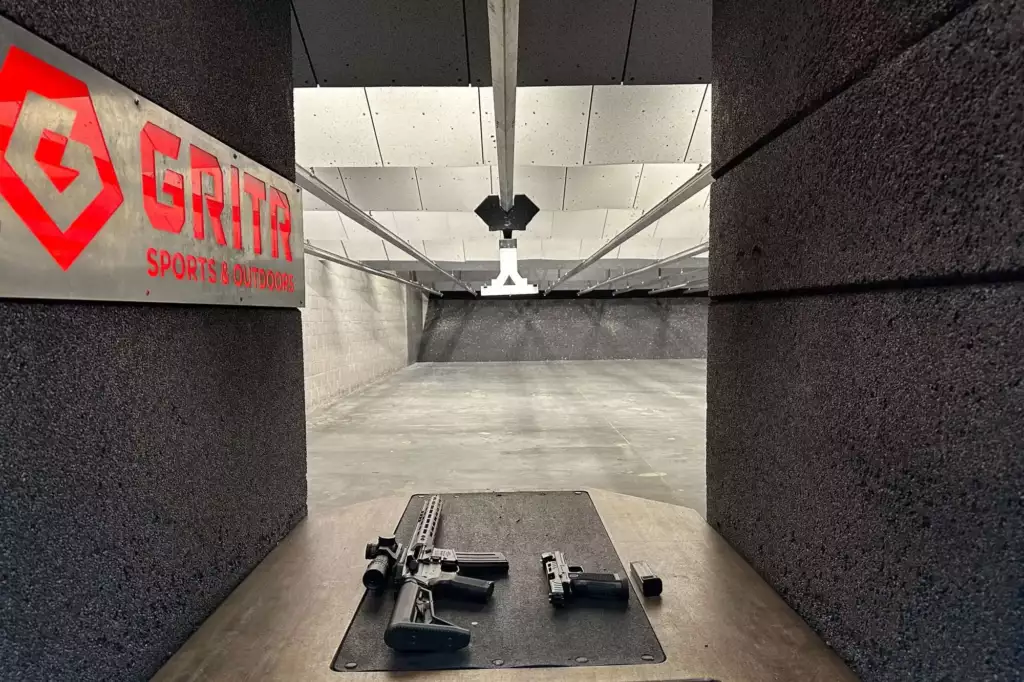
At GRITR, the range portion takes roughly 1 hour. Targets are provided. If you don’t own hearing or eye protection, rentals are available – as are rental handguns if you don’t have your own gun yet.
Malfunctions
If your gun jams mid-string, work through it. Don’t look at the instructor, don’t put the gun down – clear the malfunction and keep going. Any unfired rounds within a timed string are scored as misses. Stay calm, handle it and move on.
Are Red Dots Allowed?
As of 2023, red dot and green dot optics are permitted in the qualification. Magnified optics and lasers are not. If you carry a handgun with a red dot sight daily, you can qualify with it (which is sensible, since you should qualify with the equipment you actually use).
What to Bring to the Range
- A handgun (semi-automatic or revolver, .22 caliber or higher) + 1 empty magazine (if using a semi-auto)
- At least 50 rounds of ammunition
- Eye and ear protection
- Closed-toe shoes and a high-neckline shirt (required for safety)
Red-dot optics (without magnification) are permitted as of 2023. Lasers are not.
GRITR has rental handguns and hearing/eye protection available if needed. Ammo can be purchased at the range for an additional cost. If you’re under 21, note that federal law prohibits GRITR from renting you a handgun or selling you ammunition, so bring your own.
The qualification is not a shooting lesson. If you’ve never fired a pistol before, get some range time first. The class won’t teach you how to hold a gun or manage recoil. Take a basic firearms class and get some range time to develop good habits.
At GRITR Range, we have two basic pistol classes – Basic Handgun Safety class that teaches you safe handling habits as well as Intro to Basic Pistol Skills that goes a bit further equipping you with fundamentals of pistol manipulation – grip, reloads, aiming, drawing from OWB, and more.
Pistol Training in DFW
Basic Handgun Safety
Intro to Basic Pistol Skills
Pistol
Marksmanship 1
Pistol
Marksmanship 2
After the Class: What Happens Next
Once you’ve passed both the written exam and the shooting test, you’ll receive your LTC-104 form, which is the training form you’ll submit to Texas DPS with your carry license application. Parts B and C (range instruction and proficiency demonstration) get signed at the range; Part A (classroom instruction) gets signed by the course provider.
From there, the steps are:
- Submit your online application through Texas DPS
- Schedule fingerprinting through IdentoGO
- Submit your completed LTC-104
- Wait. DPS typically takes 7-12 weeks to process and mail your license
Total cost for GRITR’s in-person class (co-ed or women-only): $69.99. The state application fee is an additional $40. Fingerprinting carries its own charge.
GRITR also offers an online classroom option at $89.99 for those who prefer to complete the theory portion at home before coming in for the range qualification separately.
Your initial LTC is valid for 4 years. Renewals run 5 years and cost $40.
FAQs
Yes, especially if you travel, want to carry in places where permitless carry isn’t allowed, or want faster firearm purchases. The LTC also grants reciprocity in 37 other states. The class itself provides a working knowledge of use-of-force law that most gun owners lack.
The written exam covers material taught directly in the classroom – it’s a 25-question assessment, not a legal bar exam. Pay attention during the lecture and you’ll pass. The shooting qualification requires hitting a silhouette target at distances most people can manage with minimal practice. The passing score of 70% leaves a margin for imperfect shots.
A 25-question assessment covering the 4 classroom modules: laws and deadly force, handgun use and safety, non-violent dispute resolution, and safe storage. Questions come from material presented during the classroom session.
25 questions, drawn from the 4 required classroom modules.
The full proficiency demonstration (Parts B and C of the LTC-104 form) consists of 1-2 hours of range instruction followed by the 50-round shooting qualification. Both must be administered by a Texas DPS-certified LTC instructor.
It’s a 50-round course of fire shot from 3, 7, and 15 yards against a B-27 silhouette target. You need a score of 175 out of 250 possible points to pass. The instructor directs every stage, you don’t need to memorize the course beforehand.
Yes, as of 2023. Red dot and green dot optics without magnification are permitted. Lasers are not allowed.
Either works. The qualification requires a handgun of .22 caliber or higher. If you don’t own one, GRITR Range has rentals available.
You can retest. The DPS doesn’t limit the number of attempts, though individual instructors may have their own scheduling policies. If you’re concerned about passing, get range time with your specific handgun before showing up (familiarity with your firearm makes a significant difference).
Once you complete the class, get fingerprinted, and submit your application, Texas DPS typically processes and mails your license within 7-12 weeks. Incomplete applications or additional background check requirements can extend that timeline.
Yes. Under Texas’s permitless carry law, eligible Texans can carry a handgun in their vehicle without a license. However, there are restrictions on where the handgun can be placed and under what circumstances. An LTC removes most of the ambiguity.
Yes, in states that recognize the Texas LTC – currently 37. Reciprocity agreements change, so checking the Texas DPS website before traveling is a good habit.
Prohibited locations include schools and school grounds, polling places on election days, courts, secured airport areas, correctional facilities, hospitals, amusement parks, bars deriving more than 51% of income from alcohol sales, and any location that has posted appropriate 30.06 or 30.07 signage. Active governmental meeting rooms are also off-limits while meetings are in session.
The state application fee is $40. Fingerprinting runs separately through IdentoGO. Training fees vary by provider (GRITR Range charges $69.99 for the full in-person LTC class).
Felony convictions, certain misdemeanor convictions (including deferred adjudication), pending criminal charges, a history of chemical or alcohol dependency, specific psychological diagnoses, and active protective or restraining orders. The full eligibility criteria are outlined in Texas Government Code §411.172.
Texas residents and legal residents of other states who meet DPS eligibility criteria. Non-U.S. citizens who are lawfully present in the country may also qualify. Individuals aged 18-20 can obtain an LTC following a federal court ruling that struck down the previous age restriction.
Yes. Legal residents of other states (or those relocating to Texas with intent to establish residency) can apply. They must complete training in Texas, submit the appropriate forms, and provide documentation including an out-of-state driver’s license or ID.