

You’re living in a world largely designed for right-handed people, from the instruments you play to the tools you use daily. Firearms aren’t an exception. That’s why we’ve decided to break down what truly matters when choosing and training with a gun as a lefty.
The Two Options
True lefty-handed pistols are rare, often expensive, and not typically designed for concealed carry.
That leaves you with two main options: either find a lefty-friendly true ambidextrous pistol or learn to operate right-handed controls.
The first prioritizes speed and relies on muscle memory. Advocates for this approach argue that having controls that fit their natural grip and motion is key for performance under stress.
The second option is about being more adaptable. “Adapt and overcome,” they say. The logic here is that most guns (and their holsters and accessories) are designed for right-handed users, and mastering to operate right handed controls gives you the flexibility to pick up almost any gun and use it effectively.
Some people even go a step further and train to shoot with their non-dominant hand. But for many, the fine motor skills needed for a precise trigger pull feel more natural and intuitive with their dominant hand. While you can train your non-dominant hand, it might never feel as steady or reliable in high-pressure situations.
There’s no single right answer here; it comes down to personal preference and what you’re willing to train for. Many opt for a gun with a reversible mag release but a standard slide stop.
Mastering Pistol Controls for Left-Handed Shooters
Let’s get into the specifics of the controls and how lefties handle them.
Slide Stop/Release
The slide stop locks the slide to the rear when the magazine is empty. To release it and chamber a round after reloading, you have either to use the slide stop/release lever or to “slingshot” (rack) the slide.
Slingshotting the slide: This is the most recommended technique. After inserting a new magazine, grip the rear of the slide with your right (support) hand, pull it back slightly, and release it. This method is universal across almost all semi-auto pistols, making it a reliable skill regardless of the firearm. Plus, it’s easier to perform under stress than the fine motor movement (hitting a small lever).
Using your index finger: Some shooters with longer fingers can reach the slide release with their left index finger without significantly altering their grip. It takes practice but can be efficient.
Ambidextrous levers: Ambidextrous pistols like the Glock Gen 5 or many HK models have a slide release on the right side of the frame, which is perfectly positioned for your left thumb.
Magazine Release
Here’s how lefties can drop their empty mags quickly:
Middle or index finger: The most common adaptation for a standard right-handed mag release is to use your left middle or index finger. With a bit of practice, this becomes second nature and just as fast as using a thumb.
Reversible mag release: Again, many modern pistols (like Glock Gen 5, SIG P365, S&W M&P) feature a mag release that can be swapped to the right side of the frame.
Manual Safety
If you choose a firearm with a manual thumb safety (a 1911 or some S&W M&P models), this is one feature where being ambidextrous is non-negotiable for a carry gun. A safety that can only be operated from the left side of the frame is impractical and potentially dangerous for a left-handed shooter. Always look for a model with an ambi safety if you go this way.
Many popular striker-fired pistols like Glocks or the standard SIG P365 don’t have an external manual safety, which makes things simpler.
Top CCW Picks for Left-Handed Shooters
Here are some of the most frequently recommended firearms, keeping the above points in mind.
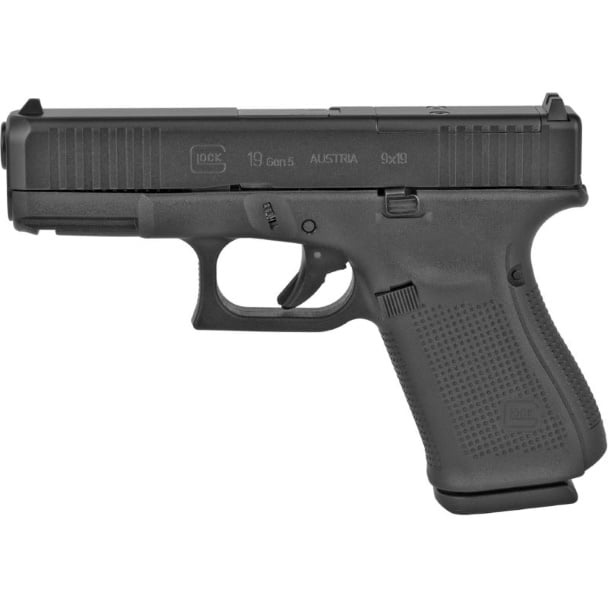
Glock (Gen 5 Models)
When it comes to reliability and aftermarket support, Glock is a household name. For left-handed shooters, the Gen 5 series was a significant step forward – models like the Glock G19, G26, G43X featured an ambidextrous slide stop and a reversible mag release.
While some users find the right-side slide release a bit stiff, the overall functionality is a huge plus. The massive availability of holsters, sights, and other accessories for Glocks makes them a practical and customizable choice for any lefty.
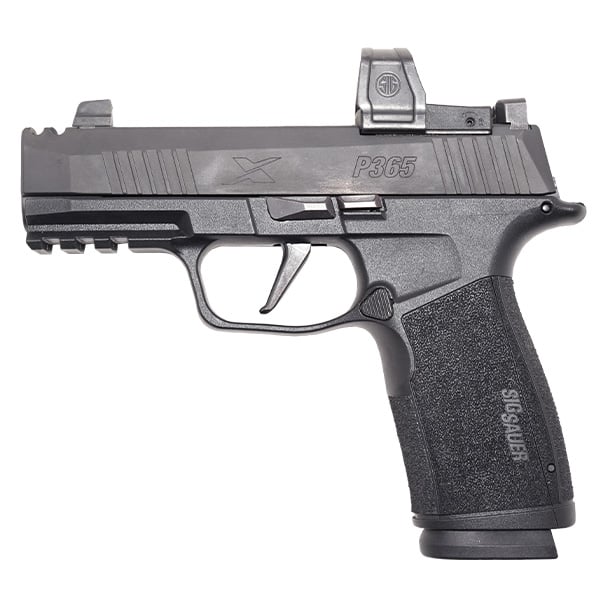
SIG Sauer (P365 and P320 Families)
The P365 series, including the popular P365X and X-Macro, offers a fantastic balance of size, capacity, and shootability. While they don’t have a true ambi slide release, the magazine release is reversible. Many left-handed shooters adapt by simply slingshotting the slide.
If you’re looking for a truly ambidextrous option from SIG, the P320 X Compact or the M18 are excellent choices. They feature full ambi controls, including slide and mag releases.
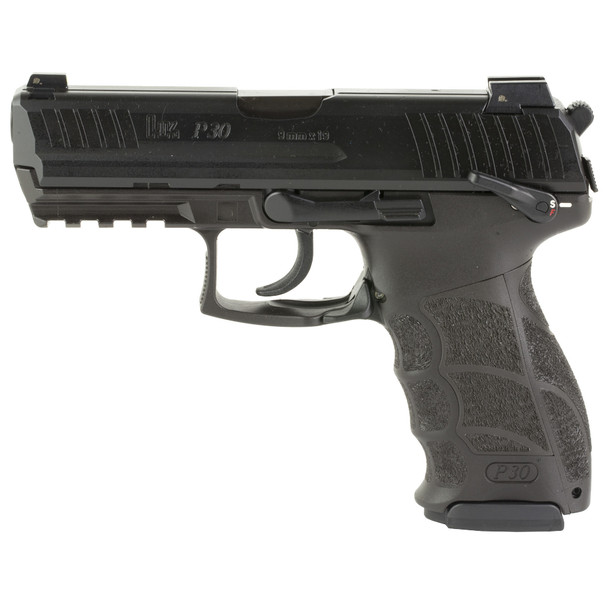
Heckler & Koch
HK has a long-standing reputation for building high-quality, lefty-friendly pistols – VP9SK, CC9 and P30SK all feature fully ambidextrous controls. A standout feature on many HK pistols is the paddle-style magazine release, which is accessible from both sides without any mods.
At GRITR Range, we have plenty of cool pistols, rifles and PCCs for rent. Some rentals sport pre-installed optics. Come try these out!
Other Pistols for Left Handed Shooters
Beyond the big three, several other manufacturers offer great pistols for left-handed shooters:
- Canik: Pistols like the TP9 Elite SC and Mete MC9 come with a reversible mag release and ambi slide stop, offering a feature-rich package at a competitive price point.
- Walther: The PDP Compact is known for its excellent trigger and ergonomics, featuring an ambidextrous slide stop and reversible mag release.
- Springfield Armory: The Echelon is a newer, modular pistol that comes fully ambidextrous from the factory, with slide and mag releases on both sides.
- Smith & Wesson: While some find the ambi slide release on the M&P 2.0 series a bit stiff, models like the Shield Plus and Shield X feature a reversible magazine release.
Beyond Left-Handedness: The Tactical Advantage
Actually, any serious shooter should train to operate their firearm with their non-dominant hand. Why? Because in a real-world defensive scenario, you might not have the luxury of using your dominant hand. First of all, your dominant hand or arm could become injured, forcing you to switch to your weak side. Also, when clearing corners or shooting from behind cover, switching shoulders can expose less of your body to a potential threat. About 50% of corners are left-handed, after all. Being proficient at shooting from your non-dominant side is a critical skill.
Find What Works for You
The best advice is to get your hands on a few of the abovementioned models. Go to a gun range that offers rentals and see what feels natural. You might find that operating a right-handed gun is no big deal, or you might fall in love with the seamless feel of a true ambi pistol. The gun you train with and feel most confident in will always be the right choice.