

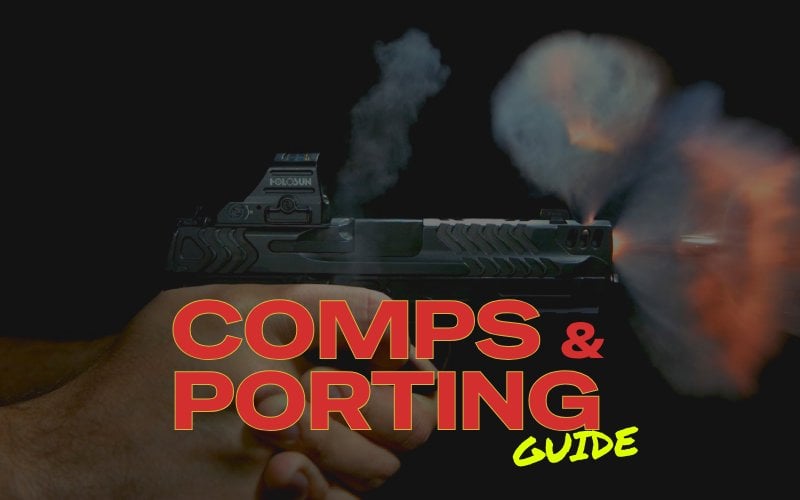
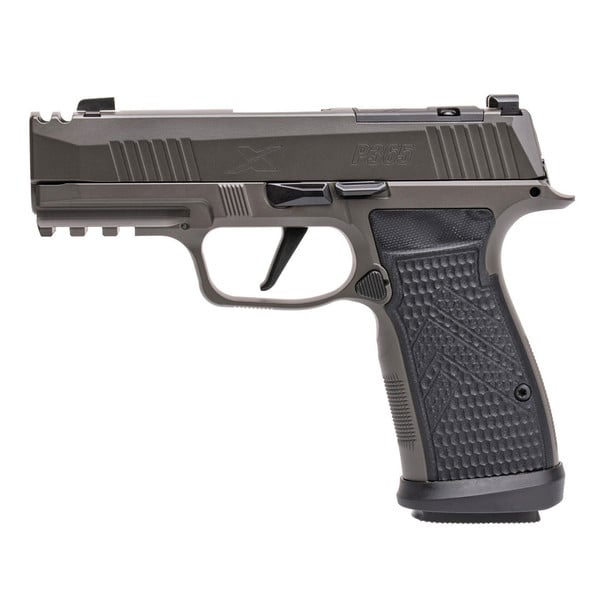
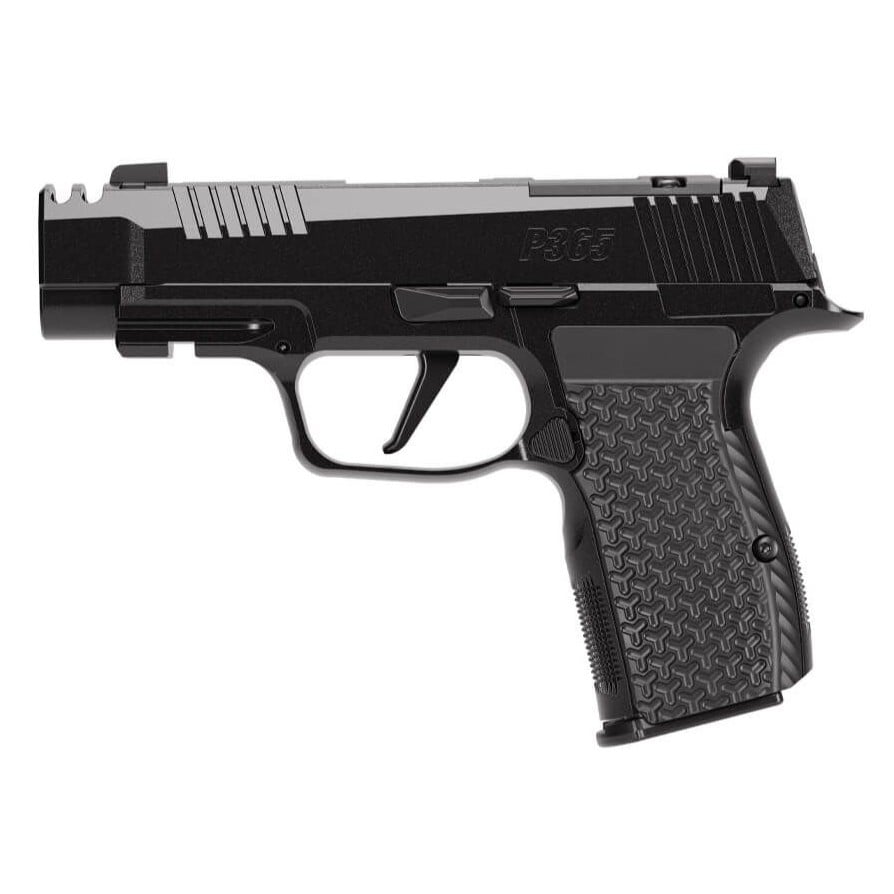
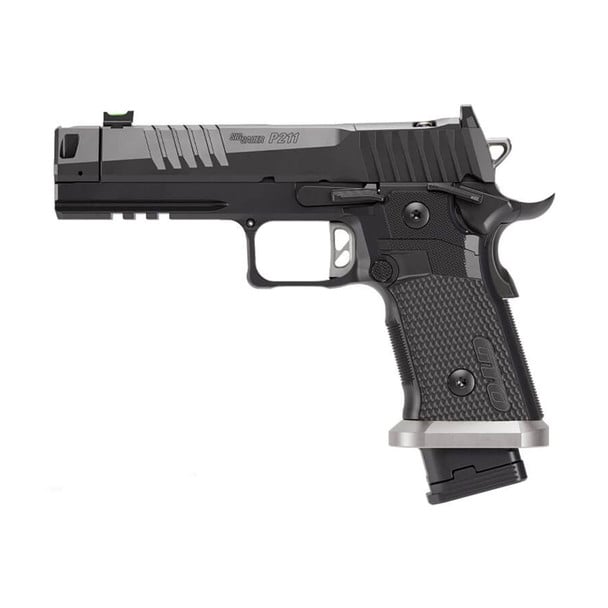
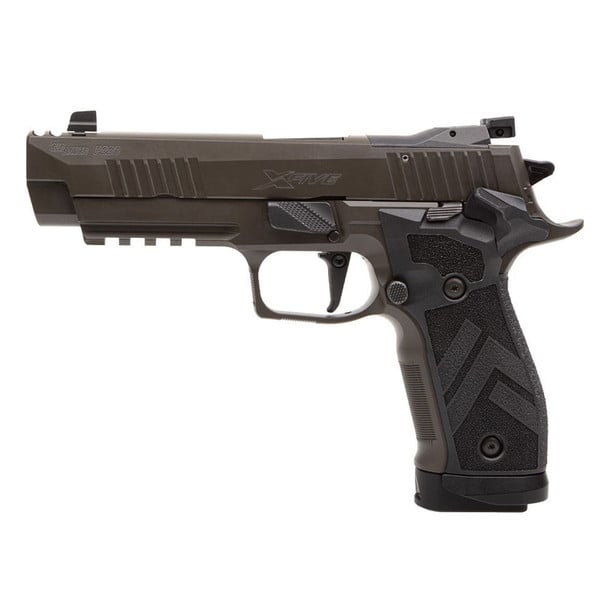
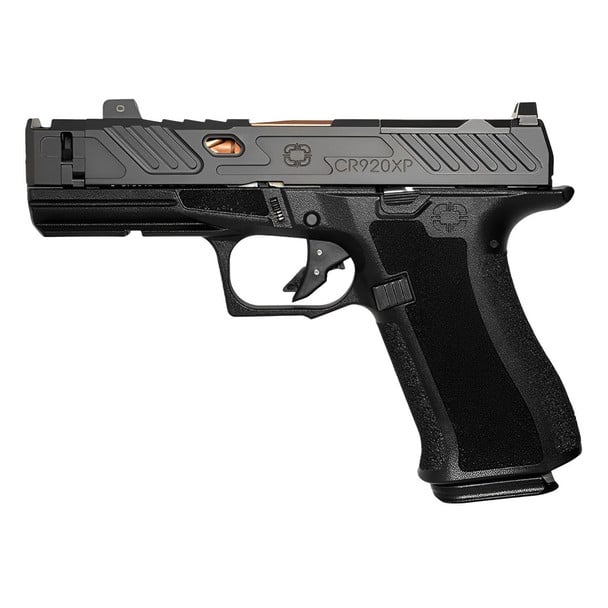
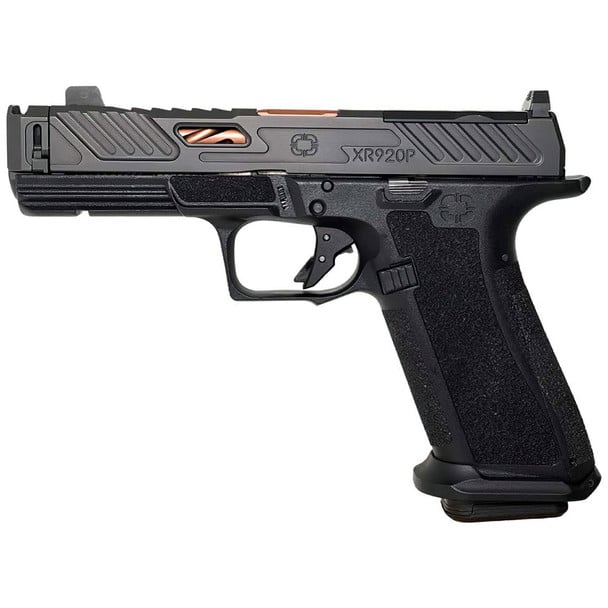
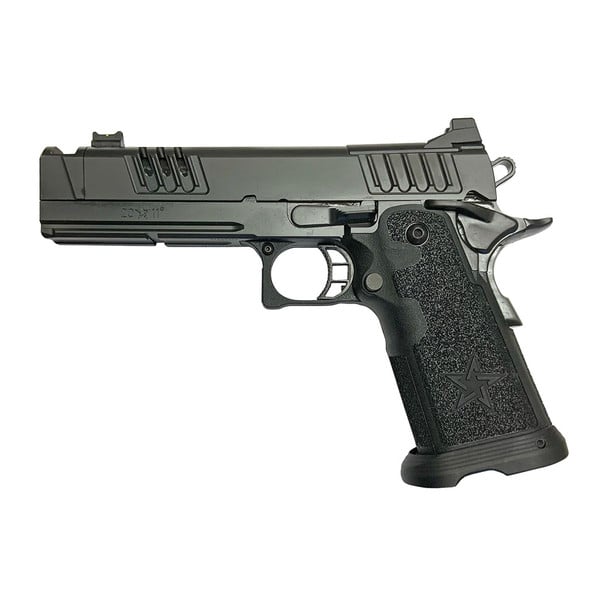
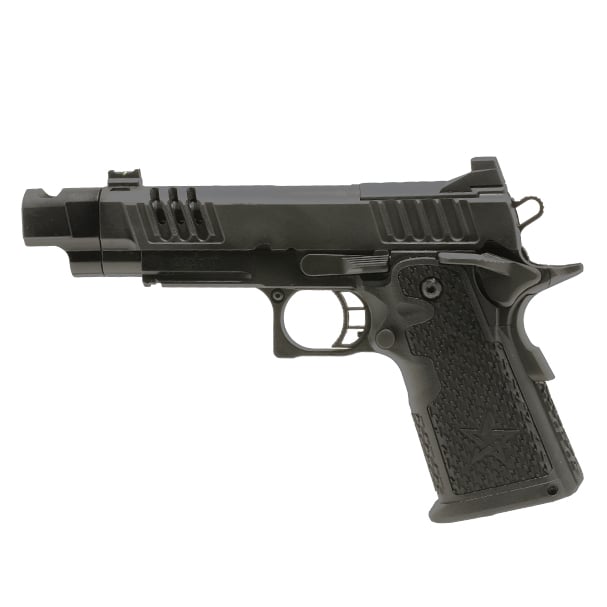
In this post, we discuss how porting and compensators (thread-on and slide integrated) impact your pistol’s performance and handling.
How Compensators / Porting Works in Pistols
The purpose of a compensator and barrel porting is to fight muzzle rise by redirecting propellant gas. When a cartridge fires, expanding gas pushes the bullet down the barrel while simultaneously pushing the barrel backward and upward. The barrel wants to pivot around your grip, lifting the muzzle, while a comp or porting counters this by venting gas upward or sideward, creating downward force that opposes the climb.
Now, let’s discuss how each solution works exactly.
Ported barrels feature holes machined directly into the barrel’s top surface, typically 1-2″ back from the muzzle. As the bullet passes these ports while still accelerating, gas escapes through the ports, countering muzzle rise at the exact moment it begins. The advantage is simplicity – ports become part of the barrel itself, no additional components needed. The downside is the velocity loss. Bleeding gas before the bullet completely exits means less pressure pushing that bullet forward. Tests show velocity drops between 30 and 70 fps depending on port size and placement.
External compensators mount to threaded barrels. The bullet exits completely before gas enters the compensator’s expansion chamber. This preserves velocity – testing confirms compensated guns run essentially identical numbers to stock barrels, sometimes slightly faster due to the added barrel length needed for threading.
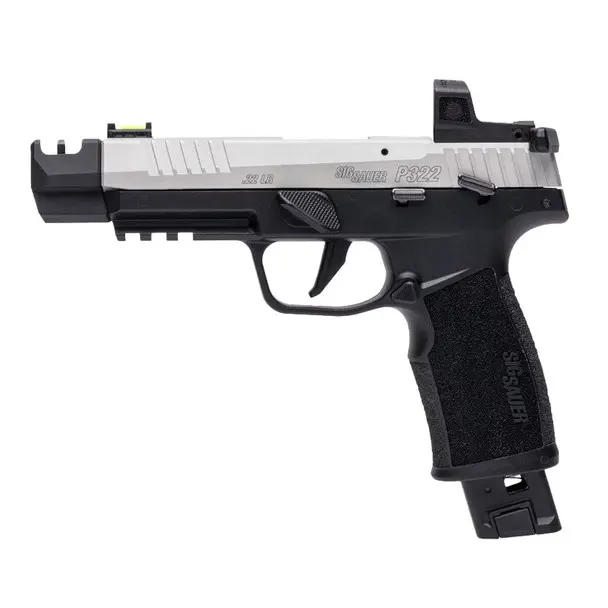
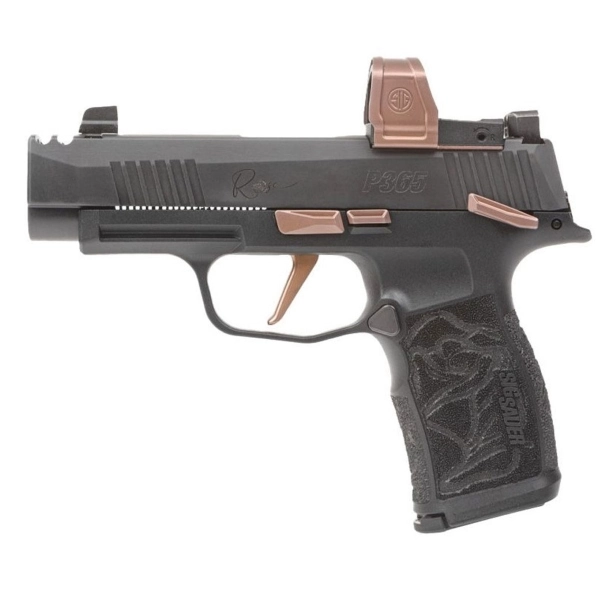
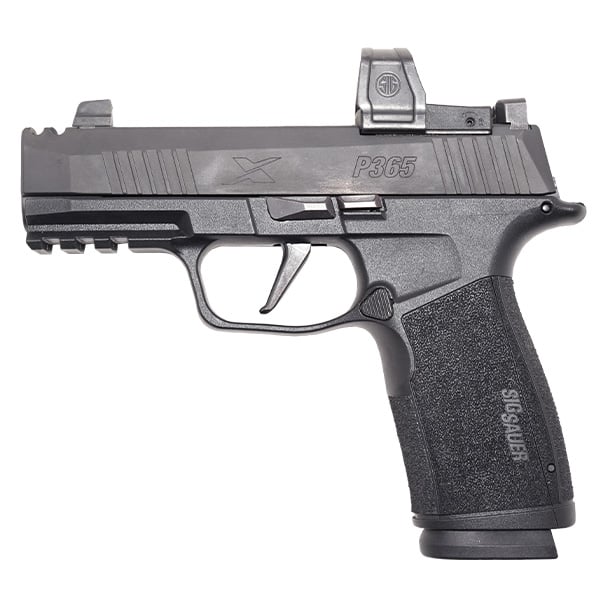
Integrated (aka slide cut) compensators split the difference. Companies like SIG (XMacro Comp) and S&W (some Carry Comp variants) machine compensator ports directly into the slide itself. For instance, S&W’s PowerPort uses a large single vent rather than multiple small ports. The main advantage of an integrated comp is factory reliability. Plus, they retain the compact footprint of the original gun.
COMPENSATED PISTOLS FOR RENT
Compensators vs Ported Barrels
Recoil Reduction
Ported barrels consistently reduce muzzle rise more effectively – roughly 20% compared to non-ported barrels (Shiled X Carry Comp and CZ P10 C Ported). Professional porting from competent gunsmiths delivers the flattest shooting, with reductions approaching 25-30%.
Compensators typically achieve 13-15% reduction. That difference translates directly to split times. Shooters running timed drills with identical platforms report noticeably faster follow-up shots with ported barrels.
Compared to slide-integrated comps, external compensators, with multiple ports, large expansion chambers, and sophisticated baffle arrangements, tend to offer a more aggressive performance.
While inferior to thread-on designs, slide cut compensators do soften the recoil, usually by 10-15% compared to a naked barrel.
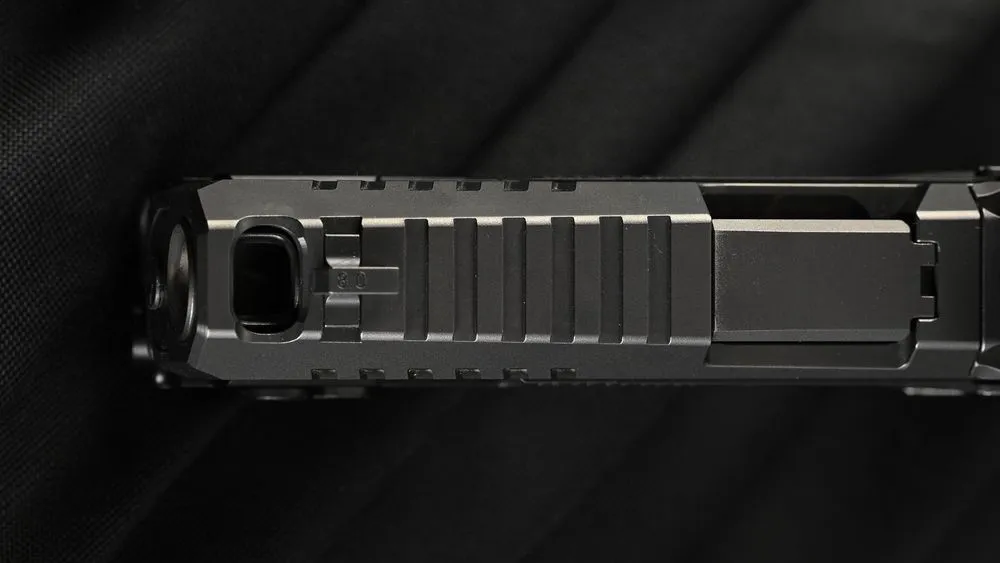
Experienced shooters often say that a slide cut comp changes the character of the recoil rather than softens it the way thread-on comps and porting do.
Velocity Loss
The price of efficient recoil reduction produced by a ported barrel is reduced velocity. The 30 to 70 fps loss might seem trivial on paper, yet competitive shooters worrying about power factor need to account for it.
Moreover, defensive carriers using ammo already operating near expansion thresholds should pay attention too. Most quality hollow points (like Federal HST and Speer Gold Dot) will still expand reliably, but you’re starting with less energy.
Also, a velocity loss can affect penetration and time-to-target, complicating shot placement on moving targets.
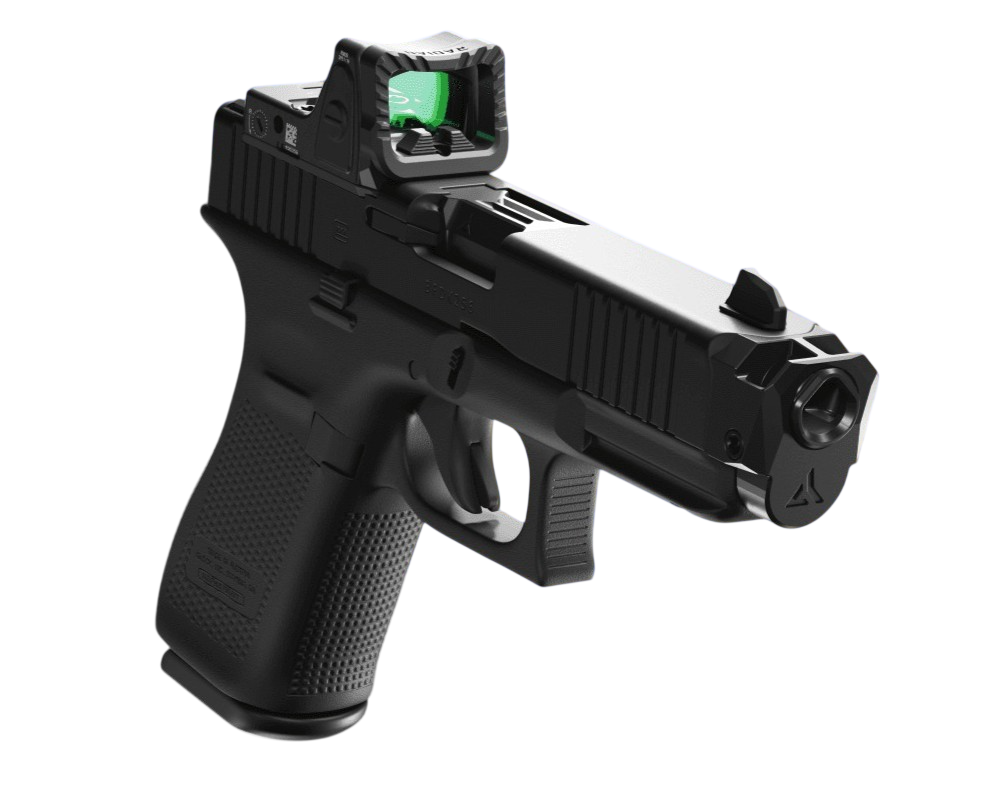
On the other hand, compensators preserve the velocity your cartridge and barrel length can deliver.
Still, careful ammo testing is strongly recommended regardless of what you will choose, especially if you intend to use your gun for defense or concealed carry. Chronograph your carry ammo through your actual gun and verify expansion through ballistic gelatin if possible.
Reliability
Both comps and ports might cause malfunctions in systems that aren’t properly tuned.
Generally, pistols with ported barrels are less prone to malfunctions but might show weak ejection patterns. You can fix this with lighter recoil springs or special recoil reduction systems.
Also, don’t forget that ported guns will always have more fouling, which also can cause malfunctions.
Screw-on compensators cause the most reliability headaches since you’re adding a component the pistol wasn’t designed for, which means the stock recoil spring is probably too heavy now, resulting in stovepipes or short-stroking.
This becomes especially pronounced with striker-fired pistols where the slide must overcome both recoil spring and striker spring resistance. Hammer-fired pistols face less of this issue. During slide movement, the main resistance comes from the recoil spring. The hammer spring only gets partially tensioned by the slide’s rearward motion.
The fix requires swapping to a lighter spring. Most people start by dropping a few pounds from their stock spring weight and testing from there.
Another issue with thread-on comps – they loosen over time. Set screws back out from vibration. Even with threadlocker, heat from shooting can break down the adhesive. When a comp spins out of alignment, you’ll get erratic performance and potentially dangerous gas venting.
Slide cut compensators ran without hiccups since they bleed less gas than ported barrels and don’t restrict the barrel/slide relationship like external comps can. Manufacturers design factory-compensated guns to work with factory springs and standard ammunition.
Still, manufacturing tolerances can vary between individual firearms. That’s why two people might have completely different experiences with guns with identical specs.
Safety
Ported barrels create the shrapnel issue, which compensators avoid entirely. As bullets pass through barrel ports, copper jacket material and unburned powder eject sideways at high velocity. This can cause injury during close-quarters shooting, especially retention positions where the gun stays near your body.
Compensators give a gas blowback only, no shrapnel. They vent gas forward and upward, away from the shooter. The blast feels unpleasant and creates more concussion, but it won’t send metal shards into your skin.
Concealed Carry
While better at recoil management than slide cut compensators, external comps add length – typically 3/4 to an inch beyond your existing slide. That obviously matters for concealment, especially appendix carry.
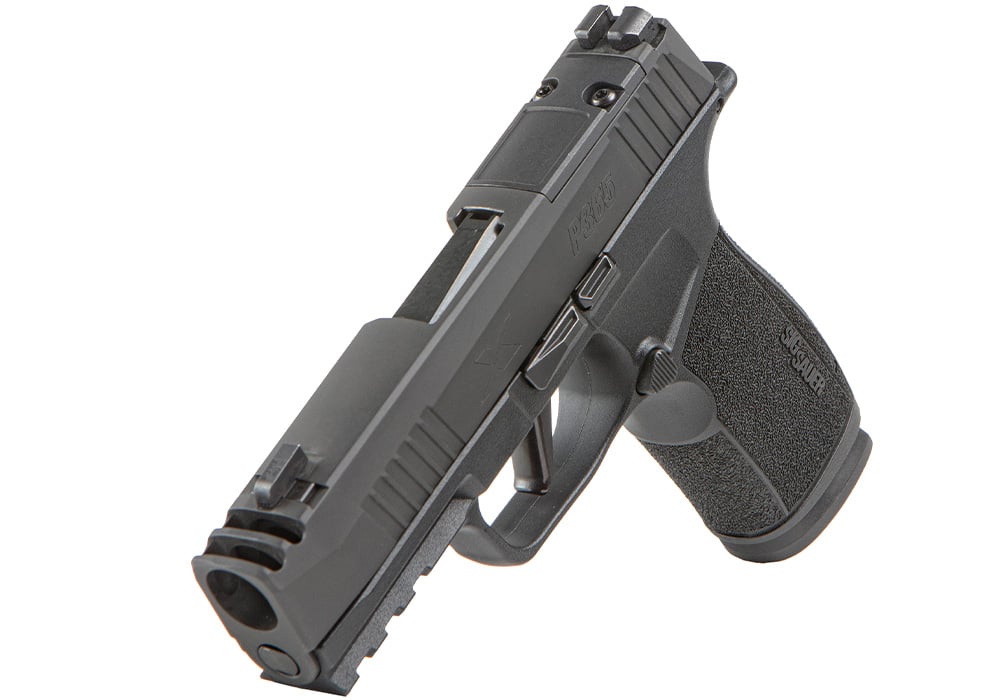
Slide-integrated compensators keep things simpler. Everything stays within the gun’s original footprint or adds minimal length. Springfield’s Hellcat compensated models actually remain compatible with standard Hellcat holsters because the comp doesn’t extend past the slide. Same for the Sig P365 XMACRO.
Shooting a Comped / Ported Pistol in the Dark
Compensators don’t reduce flash but redirect it – upward instead of forward.
In Nightwood Guns tests where they were night shooting with various compensated and ported pistols showed flash patterns vary wildly between designs. S&W’s ported barrel creates a fairly narrow vertical plume. FN’s QD comp with V-shaped ports pushes flash outward at an angle, keeping it out of the shooter’s direct line of sight. Side-venting designs create dramatic horizontal jets that look impressive on camera but don’t significantly interfere with the shooter’s vision.
Interestingly, aggressive porting (V8 style) didn’t cause blindness or complete loss of night vision, but it left noticeable afterimages after several shots. The flash doesn’t prevent accurate shooting, though, as long as you stay target-focused rather than fixating on the flash.
What did affect shooting was the increased brightness of red dots set to auto-adjust mode. Trijicon RMRs and Holosun models both flared noticeably brighter during firing with compensated guns compared to standard pistols. This wasn’t debilitating, but it was noticeable. Manual brightness settings eliminated the issue.
Someone unfamiliar with the effect might find it startling initially, but firearms training and experience reduce that reaction.
Also, activating the weapon light before shooting washes out the muzzle flash completely. This assumes you can deploy the light in time, which may not always be possible.
Pistol Training in DFW
Basic Handgun Safety
Intro to Basic Pistol Skills
Pistol
Marksmanship 1
Pistol
Marksmanship 2
Ammo Selection for Compensated Carry Pistols
Сompensated pistols work differently with different ammo loads, which means you need to select your ammo carefully and perform extensive testing before committing to a certain load. The performance shift shows up most clearly when switching from defensive loads to cheaper practice ammo – the lighter bullet and reduced pressure meant less gas for the port to work with.
This creates a dilemma for carriers who train with cheap ammo. Your gun shoots differently between practice and carry configuration. The magnitude of this difference varies by platform. Factory-integrated comps (FN 509 CC Edge, S&W Carry Comp, SIG P365 XMacro) generally show less variation because they’re designed around standard pressure ranges. External comps show much wider performance swings between loads.
You either accept the difference and adjust accordingly, or commit to practicing with your carry ammo (heavier and +P loads).
At GRITR Range, we have plenty of cool pistols, rifles and PCCs for rent, including Glocks and Shadow Systems. Some rentals sport pre-installed optics. Come try these out!
Making the Decision
Start by honestly assessing your current skill level. Can you already deliver rapid, accurate hits with a stock gun? Have you plateaued in your performance despite continued training? If not, your money and time go further investing in ammunition and instruction rather than modifications.
If you do decide to run a compensated carry gun, commit to the process fully. Budget for a quality threaded barrel (if going external), the compensator itself, potentially lighter springs, and several hundred rounds of your carry ammo for testing. Find a reputable gunsmith or manufacturer with a proven track record – this isn’t the place to cheap out.
Keep in mind that even match-grade aftermarket components require a break-in period.
Integrated compensators from major manufacturers (SIG, Smith & Wesson, FN) offer a simpler path forward. These factory-designed systems generally prove more reliable out of the box and avoid the tinkering often required with add-on compensators. They’re shorter than external models, easier to holster, and require no barrel threading concerns.